Hi Molly! Can you tell us a bit about yourself and your role on the Geec team?
Sure! I’m from Kilmaley, County Clare, and this summer I’m working as an energy engineer with Celtic Dynamics. In September, I’ll return to my mechanical engineering studies at the University of Galway and continue working with the Geec team alongside that. I’ve been involved for the last two years, mostly as a driver, but also recently as the maintenance team lead.
How did you first get involved with the Geec and the Shell Eco-Marathon?
I first heard about Geec at an open day while I was still in secondary school. A student involved in the project spoke to me about it, she later became team lead and I ended up working with her the following year! She really sold both the project and the university to me. It helped make the idea of college feel more real and achievable.
I originally didn’t apply to be a driver, I thought I was too tall! But a few months in, they hadn’t found someone, and managed to “squeeze me in,” so to speak.
What inspired you to study engineering?
Growing up, I spent a lot of time doing projects with my dad. I probably wasn’t much help at the time, but I think I’ve improved! I’ve always enjoyed solving problems and being hands-on. Engineering gives you the chance to design, think creatively and work on real-world challenges.
What was your role in preparing for this year’s Eco-Marathon?
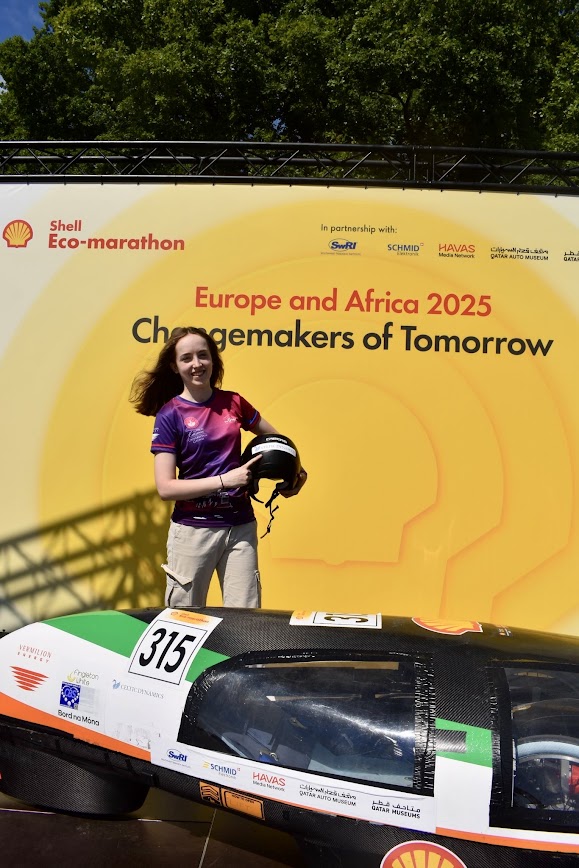
As a driver, I focused a lot on track testing, giving feedback on car handling and performance, and helping interpret data to shape race strategy. I also took on a new role this year as maintenance lead, which meant working in the lab weekly to install upgrades, troubleshoot systems and ensure reliability.
A big focus for me this year was optimising the bearings and steering alignment, anything we could do to reduce mechanical losses and increase coasting time on the track.
 What were some of the challenges the team faced this year?
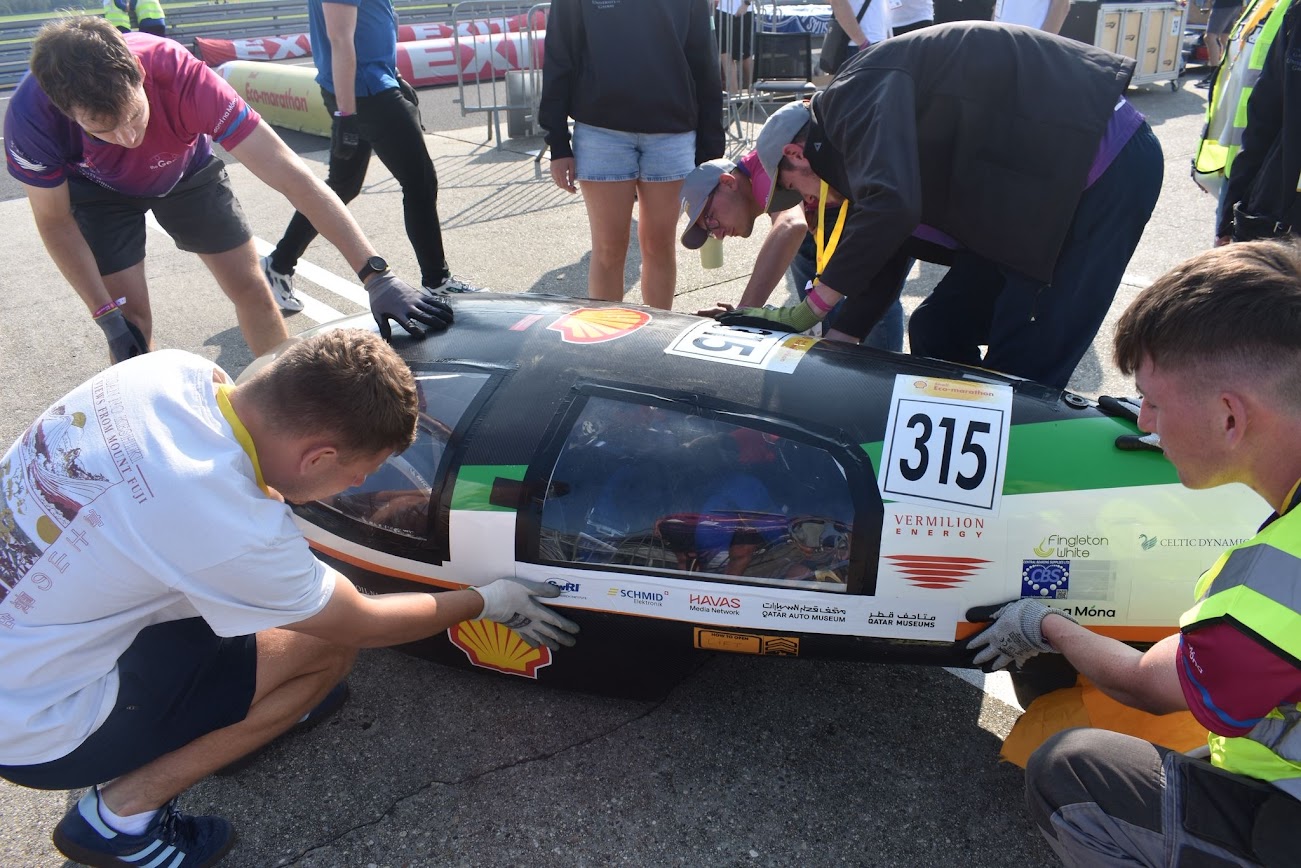
Honestly, getting the car to Poland was the biggest challenge! In past years, we went to places like France and the Netherlands by ferry, but air travel adds complications, especially with the battery, which can’t just go on a plane. But we made it work in the end.
Were there any innovations or improvements to the car this year?
Definitely. A lot of the major developments come from our Master’s students, who base their thesis work on the Geec. This year, we had projects focused on drivetrain, power electronics, simulation work and a dynamometer. I helped provide driver feedback when needed for some of these projects, but most of my work was related to the bearings, learning how they’re supposed to work versus how they actually behave and trying to bridge that gap.
What was it like driving in the competition in Poland?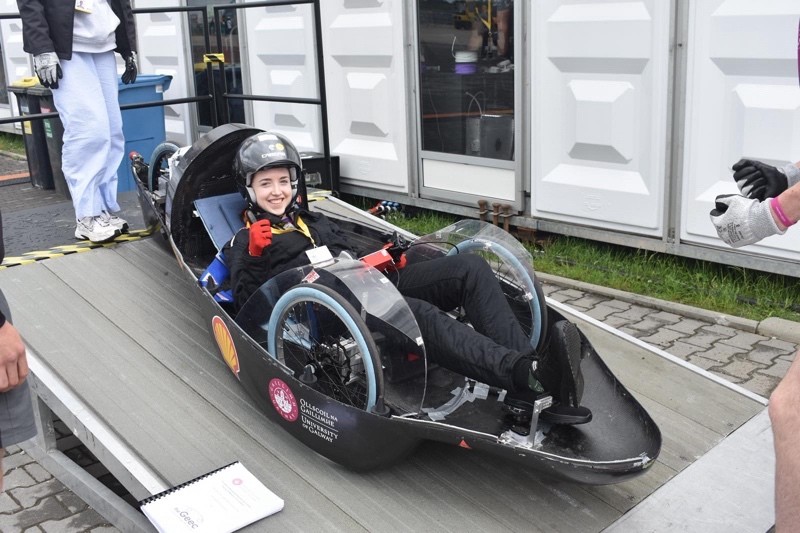
It was… intense! The inside of the car gets incredibly hot, up to 45°C, even if it’s only 27°C outside. I think I lost about 4 kilos during the week, despite having two dinners a night! The visibility is also quite limited because you’re lying so flat, so situational awareness is tough.
But despite that, it’s such a unique and amazing experience. I know a lot of the team would love a chance to drive.
How did you prepare, both technically and mentally, for driving?
Technically, it was about setting up communication, having teammates stationed at various track points to radio in and warn me about other cars, since visibility is poor in some sections. I also had to monitor the display and give feedback in real-time, like current draw for the team to process and adjust our strategy.
Mentally, I felt much more relaxed this year. Being involved in the strategy and build gave me more confidence and a deeper understanding of how everything worked.
Did anything unexpected happen during the event?
Yes, the heat affected everything. Some teams had serious mechanical issues, like brakes expanding mid-race and damaging their drivetrains. We didn’t suffer anything major, but in one race, I lost both the display and communications, so I had to complete the run without knowing my energy usage, timing, or if there was a car in front of me. I just had to go for it and hope for the best!
What did this project teach you about sustainability and engineering?
This kind of work really suits me because I learn best by doing. The Geec gives you so much room to take initiative, you can jump into whatever part of the car interests you. Before joining, I wasn’t even that into cars, which is funny for a mechanical engineer to say! But this opened up a whole new world.
It also gave me more exposure to energy systems and electronics, which helped lead me into my current energy engineering role.
 How does this experience connect to your future goals?
It really solidified my interest in energy engineering. I love seeing a project progress from start to finish. And I’d definitely like to keep travelling with my work, this project brought me to France last year, Poland this year, and hopefully Poland again next year. The opportunities are amazing.
Why do you think competitions like the Eco-Marathon are important?
They give students, especially younger years, a chance to get real, hands-on experience early in their degree. In big classes, it’s easy to feel lost, but a project like this helps you find your community, learn directly from older students, and build something together. I was the youngest on the team last year, and having that network helped me settle in and stay motivated.
What was the team dynamic like?
The team was great fun. We had only three returning members from last year, so most of the group had never been to a competition before—but we clicked right away. The campsite was a blast, teams from all over Europe, DJs, late-night chats. The atmosphere definitely helped us perform well, too.
What’s something you learned about yourself or engineering during all this?
Murphy’s Law: if it can go wrong, it probably will. But I’ve learned that it’s all about how quickly you adapt and respond. That mindset really matters in engineering.
What advice would you give to studentsthinking of joining a team like Geec?
Just go for it. Whether it’s the travel, the hands-on experience, or the people you meet, it’s worth it. Especially in first year, it gave me a smaller, more
connected group to work with, which made the transition from school to college so much easier.
What’s next for you and the Geec team?
We’re already planning ahead, meeting with lecturers, reviewing this year’s performance, and figuring out how we can improve. We’ve got ideas around new tires, reducing mechanical losses, and hopefully beating our 354km/kWh score from this year. It’s all in motion.
How can people follow or support the Geec team?
Check out our website at www.thegeec.ie, or follow us on Instagram, Facebook, and LinkedIn, those are the most active. If anyone’s interested in sponsoring the team, they can reach out to our sponsorship manager, Joseph Martin, at j.martin28@universityofgalway.ie.