District Heating: Could It Transform How Ireland Heats Its Cities?
Overview
 How we heat our buildings is becoming one of the biggest challenges in Ireland’s energy transition.
While much of the conversation has focused on retrofitting homes and installing individual heat pumps, another solution has been quietly heating towns and cities across Europe for decades. District heating has already been adopted by millions of people, offering a way to improve energy security, reduce carbon emissions and make better use of energy that would otherwise go to waste.
In this episode of The Energy Canvas, Dylan Walsh, CEO of Celtic Dynamics, is joined by David Connolly, CEO of HeatGrid Ireland and Chairperson of the Irish District Energy Association. Together, they explore how district heating works, why it has been so successful across Europe, and what needs to happen for Ireland to begin adopting it at scale.
What We Cover
- What district heating is and how it works
- Why district heating became widespread across Europe
- How district heating improves energy security
- Using waste heat to heat towns and cities
- District heating compared with individual building retrofits
- The barriers slowing adoption in Ireland
- Government support and infrastructure investment
- The role of district heating in decarbonisation
- What Ireland’s heating system could look like in the future
Key Takeaways: District heating centralises how we produce heat
Rather than every building operating its own boiler or heating system, district heating produces heat at one central location before distributing it through insulated underground pipes to homes, businesses and public buildings.
This allows entire communities to be heated from a single energy source, making it much easier to transition to renewable heating technologies over time.
Waste heat is one of Ireland’s biggest untapped energy resources
One of the biggest advantages of district heating is its ability to use heat that already exists.
Data centres, industrial facilities, wastewater treatment plants and power stations all generate large amounts of excess heat that is often lost to the atmosphere.
Instead of allowing that energy to go to waste, district heating networks can recover it and use it to supply nearby homes and businesses.
As David explains during the episode, studies have shown that Ireland currently throws away more waste heat than is required to heat every building in the country.
Energy security starts long before a crisis
The conversation highlights how countries that invested in district heating decades ago were much better protected during the 2022 energy crisis.
While many countries experienced significant increases in heating costs due to volatile gas markets, district heating customers in places such as Denmark saw relatively stable prices because they relied far less on imported fossil fuels.
The key lesson is that resilient infrastructure has to be built before it is needed.
Decarbonising cities requires a different approach
Retrofitting buildings will continue to play an important role in reducing emissions.
However, David argues that large urban areas present a different challenge.
Replacing every individual heating system, upgrading electrical infrastructure and coordinating work across thousands of separate properties is an enormous task. District heating offers another pathway by allowing cities to decarbonise their heating supply through centralised infrastructure instead.
Why This Matters Now
Ireland has committed to reducing emissions while improving energy security and reducing dependence on imported fossil fuels.
Meeting those ambitions will require more than new technologies.
It will also require the infrastructure capable of delivering low-carbon energy at scale.
District heating has already demonstrated its value across much of Europe, but Ireland remains at a very early stage of deployment.
As government support schemes begin to emerge, the decisions made over the next few years will shape how Irish towns and cities heat their buildings for decades to come.
The Biggest Challenge Isn’t Technology
Throughout the episode, David makes the point that the technology already exists.
The biggest challenge is building the infrastructure.
District heating requires:
- long-term investment
- underground pipe networks
- energy centres
- planning and permitting
- collaboration between utilities, local authorities and customers
Building this infrastructure takes time, but once established it creates opportunities to continuously transition towards lower-carbon heating without requiring major changes inside every connected building.
Why District Heating Improves Energy Security
One of the strongest themes throughout the discussion is that district heating reduces reliance on imported fuels.
Instead of depending entirely on gas or oil, communities can make use of locally available heat sources including:
- large heat pumps
- waste heat from industry
- data centres
- wastewater treatment plants
- biomass where appropriate
This diversification not only reduces emissions but also protects consumers from international fuel price volatility.
What This Means for Businesses
For businesses, district heating is about much more than reducing carbon emissions.
It can also contribute to:
- greater energy price stability
- reduced exposure to global fuel markets
- improved long-term operational resilience
- simpler pathways towards decarbonisation
- future compliance with sustainability requirements
As Ireland continues to electrify and modernise its energy infrastructure, businesses will increasingly need to consider how future heating networks fit into their long-term energy strategies.
Looking Ahead
District heating will not replace every heating solution in Ireland.
However, it has the potential to become one of the most important tools available for decarbonising towns and cities while strengthening energy security.
The technology is already proven.
The challenge now is building the infrastructure, creating the right policy environment and making the long-term investment decisions that allow these systems to grow.
Guest: David Connolly
David Connolly is CEO of HeatGrid Ireland, a company developing low-carbon district heating networks across Ireland. He is also Chairperson of the Irish District Energy Association, which he co-founded in 2017.
Previously an Associate Professor at Aalborg University in Denmark, David led the Heat Roadmap Europe project, which helped inform the European Commission’s first Heating and Cooling Strategy. He has also served as CEO of Wind Energy Ireland and has extensive experience across renewable energy, national energy planning and decarbonisation.
Memorable Quotes
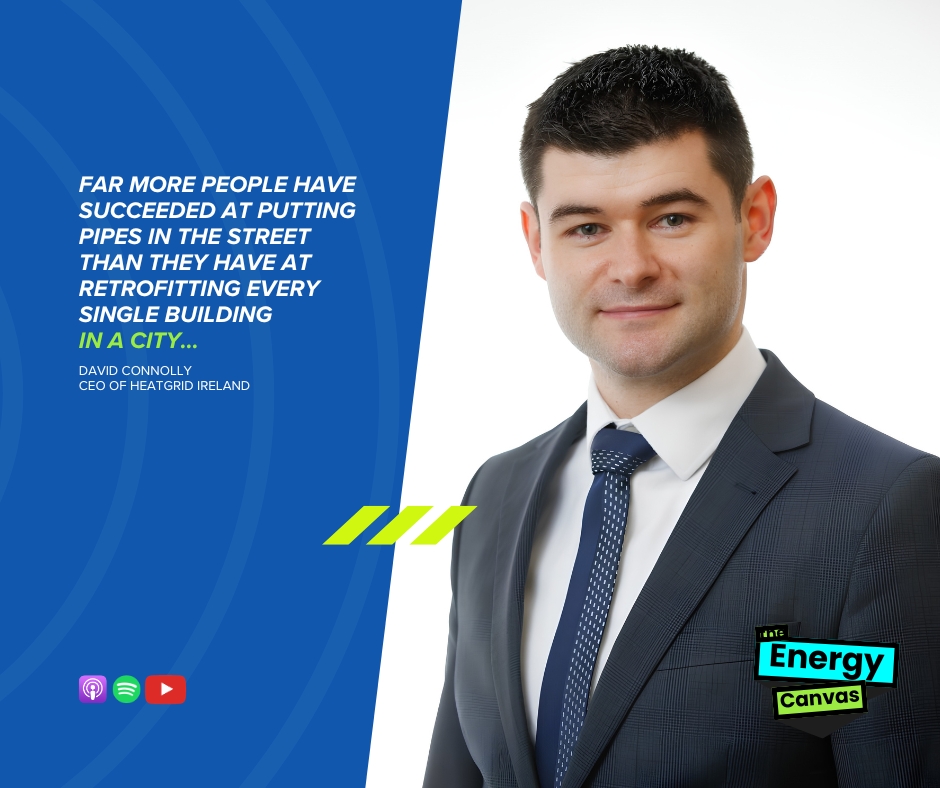
“Far more people have succeeded at putting pipes in the street than they have at retrofitting every single building in a city with an alternative low-carbon solution.”
“If you imagine now you have a boiler heating an entire city, it is much easier to replace that boiler with a renewable energy source at one location to supply all the homes.”
“Whenever there is a global shortage or crisis they do not feel this on their fuel prices because they do not use oil or gas to heat their homes any longer.”
About The Energy Canvas
The Energy Canvas is a podcast from Celtic Dynamics, exploring the intersection of engineering innovation, sustainability, and business outcomes in Ireland’s evolving energy landscape.
Produced by DustPod, the show highlights leaders, researchers, and innovators driving real climate action and decarbonisation solutions.
Get in Touch
Working on an energy project, exploring storage solutions, or trying to navigate the transition to net zero?
We work with organisations across Ireland on energy strategy, decarbonisation, and system design. If you’d like to continue the conversation, get in touch below or connect with us on LinkedIn.
We’re also always looking for new voices for The Energy Canvas, so feel free to suggest future guests or topics.